Kituwa IT · Field guide
What would you rescue first?
Four things are waiting on a decision. An old laptop that still works. Practical checks and official references.
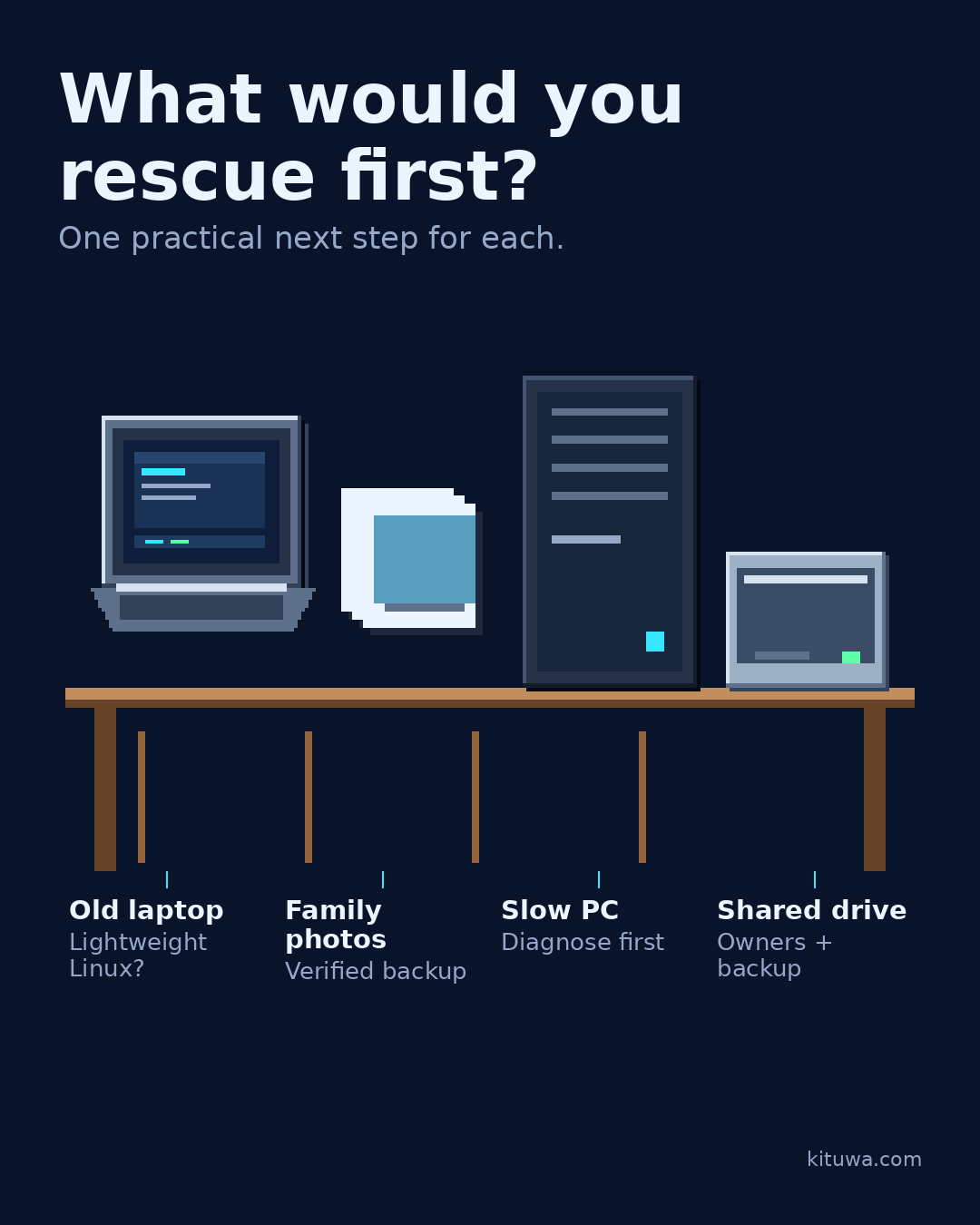
Four things are waiting on a decision. An old laptop that still works. A folder of family photos. A slow office PC. A shared drive everyone treats as a dumping ground.
This guide expands the Facebook post into a practical workflow for beginners, home-lab users, and small-business owners who want to understand the trade-offs before changing a working system.
What this guide covers
- What would you rescue first?
- One practical next step for each.
- Old laptop — Lightweight Linux?
- Family photos — Verified backup
- Slow PC — Diagnose first
- Shared drive — Owners + backup
Why it matters
The goal is not to memorize a product name or copy a command blindly. It is to understand what the change affects, verify it against an official reference, test it on spare hardware or a virtual machine when possible, and keep a rollback path.
A practical walkthrough
Protect the data first
The laptop might become a lightweight Linux machine, a backup target, or a spare browser. The photos need at least one verified copy on a separate device, and a restore test. The office PC needs diagnosis before replacement: startup load, memory pressure, disk health, temperatures. The shared drive needs owners, folders, and a backup, not just more space.
Step 2: what to check
None of these is a guaranteed miracle. Each is a practical next step.
Verify the result
Test the change on a spare device or virtual machine first. Check the exact behavior you care about, not just whether the screen looks right. Record what you tested and what you expected.
Your turn
If you could rescue one first, which would you choose — and what problem do you want solved?
What to verify
- Use the official documentation for the exact version you run.
- Test on a spare device or virtual machine before changing a working system.
- Keep a backup and a rollback path.
- Record what changed and how you verified it.
Common mistakes
- Changing more than one thing at a time.
- Skipping the official documentation for your version.
- Assuming a warning means you should delete or reset data.
- Not recording what you changed or how you verified it.
Quick checklist
- ☐ One practical next step for each.
- ☐ Old laptop — Lightweight Linux?
- ☐ Family photos — Verified backup
- ☐ Slow PC — Diagnose first
- ☐ Shared drive — Owners + backup
FAQ
What is the first step?
Four things are waiting on a decision.
What should I avoid?
Changing more than one thing at a time.
Where can I verify the current details?
Use the official references below; versions and interfaces change.
References
Related guides
Need help?
If you want a second opinion on the setup or the rollback plan, Kituwa can review it with you. Start with the checklist above; it makes the conversation more useful.